
How to choose the right practice for the state of your nervous system
Last week I wrote about deep imagery, the 5th pillar in my Somatic Immersion framework and now we're heading back to pillar #1: nervous system regulation. We're not starting over, we're spiraling. The spiral — one of nature's primary patterns — optimizes growth, strength and energy efficiency. Think sunflowers, mollusk shells, pinecones, hurricanes, the DNA double helix — even the milky way. Their growth is constant and seamless - they never outgrow the shape of their home and within the spiral, organisms don't need to destroy old structures in order to expand.
This is how the pillars feel to me. We begin with the foundation, nervous system regulation, where we find safety and connection, and as we increase our window of tolerance — the ability to bring in challenge and novelty without getting dysregulated — we grow our capacity to be with stressors without moving into fight, flight or freeze. From that place, like a spiral, we unfurl. We can interact with the parts of ourselves that feel afraid or angry or hurt, we can explore the spontaneous images that arise from our unconscious mind, we can expand our ability to both listen to and respond to our bodies with care and compassion and in doing so, we grow. We allow for more vulnerability and experience more joy and connection.
And like the rotational symmetry of the spiral, we return over and over to the same building sequence.
So today, after a month of building self-compassion, honing listening skills, having conversations with our scared parts, and exploring deep imagery that helps us find a refuge inside of ourselves, we return to where we began: nervous system regulation.
In the guided practice below, I’ll offer a few simple tools to help you first recognize the state of your nervous system and then shift it.
But before I do that, I want to talk about why understanding where you’re at first is so essential. Often times when we’re really stressed we’ll reach for a practice that we’ve learned without really knowing whether that particular practice is the one that will be most helpful. Or we’ll open our meditation app and pick a random recording.
But the truth is, we need to individualize our practices to meet the needs of the day.
If I am in a state of anxiety and my system is over-activated, I’m in a sympathetic or fight, flight state. If that’s the case, I need to calm down my system. That could look like guided relaxation or a slower paced yoga class or a gentle walk. But often times when we’re stressed out we think we need to burn off that energy and so instead we do something like power yoga, or intense cardio.
All that’s doing is adding fuel to the fire when what we really need to do is calm the flames.
On the other hand if I’m feeling checked out or numb, my system needs more energy. That’s a good time to speed things up a bit. Maybe go on a brisk walk or do some energizing breath work or a more active yoga class. In this case, we're working with embers that need to be fanned.
This is not the time to do a guided relaxation practice.
Whether you are feeling anxious or numb, when you’re dysregulated, the first step is to bring in a sense of safety and connection because that’s what cultivates a regulated nervous system. Often times we try to talk ourselves into feeling safe. We minimize or gaslight ourselves. We tell ourselves that we're fine even though inside, it doesn't feel that way.
The biggest mistake we often make is to try to think ourselves into regulation.
Your nervous system is not working at the level of cognition. Your nervous system needs to be soothed or excited in a somatic way. So we start by raising and lowering our energy through the body not the mind.
I love to find the parallels between eastern and western thought. Polyvagal theory is a western lens through which we can understand our nervous system. And if you are familiar with yogic philosophy, this lens will bring to mind the gunas, or the states of being that we are constantly experiencing.
Tamas, Satva, Rajas - these are the 3 gunas or states we are always moving in and out of.
Tamas is earth or stability. When it's balanced, it's grounded and stable. When it's out of balance, it manifests as heaviness, fatigue or depression (hypo-arousal). Rajas is action or movement. When out of balance, it manifests as anxiety, rumination, or flightiness (hyper-arousal). Sattva is harmony. It's a place of balance where we are both grounded and expansive (parasympathetic state).
Regardless of which lens we look through, we all have both tendencies and fluctuations. When we are stressed out, we tend towards too much or not enough energy in the system (hyper or hypo). And that also fluctuates based on the time of day, how we slept, what we ate, changes in the weather, our health, etc.
So the more familiar we are with both our tendencies and our fluctuations, the more readily we can feel where we are and skillfully bring ourselves back to equilibrium.
And once there, we can keep spiraling. Imagine that with each "parts" conversation, with each moment of self-compassion, and with each spontaneous image that arises, you are creating more space in your internal home — more energy and more capacity.
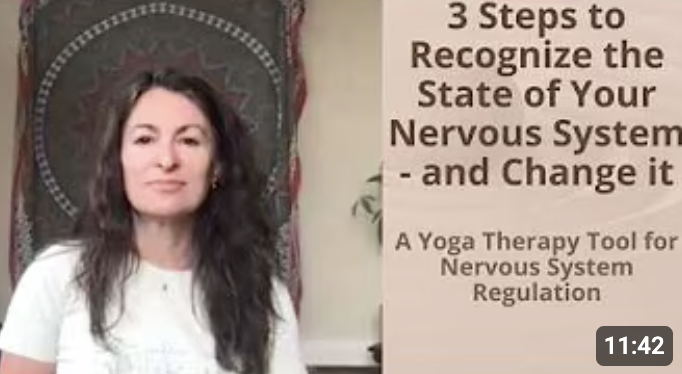
Would you like to practice this with me? In the video below, I'll review a bit and then offer a practice.
Here are the steps we'll move through:
Step 1: Notice where you’re at.
Step 2: Bring in safety and connection.
Step 3: Choose a practice that helps you make your way back to baseline whether you’re moving from a hyper-aroused state and calming the system or a hypo-aroused state and exciting the system.
If you follow the timestamp, you can skip right to the practice.
This fall, I'll be offering another round of the Somatic Immersion where we'll use discussion, meditation, breathwork, asana, and reflection to explore the spiral together.
Put your name on the Somatic Immersion waitlist and you'll be the first to know when registration opens in September!
Stay tuned for more of the 5 pillars. Next up, back to self-compassion for a deeper dive.
Thanks for reading, watching and being a part of this community. I hope our paths cross soon.
And as always, I'd love to hear from you. What's your tendency?
Sending so much love,
Rachel
Ways to work with me...
Yoga Therapy Sessions, Courses and Trainings
Work with me one-on-one. I offer yoga therapy, yoga instruction and personal and professional mentoring. Reply to this email if you'd like to chat about whether this is the right time and fit for you.
The next Somatic Immersion Yoga Therapy Journey starts in September. Join the waitlist and be the first to know when registration opens.
The next Somatic Immersion Yoga Therapy Training for facilitators begins in September. Join the waitlist and be the first to know when registration opens.
Spain Retreat
Yoga + Nature + Culture, Retreat to Southern Spain, March 14-20, 2027. Register now to save your spot - space is limited.
Yoga, Meditation and Mindfulness Classes
If you like practicing online, join the Your Yoga community! We meet on zoom for yoga and meditation 4 times a week and you'll have access to 100's of recorded classes in the Your Yoga library. Register here to start your free 7-day trial.
And if you prefer self-study, choose from a variety of pre-recorded mindfulness workshops and courses and explore at your own pace.