
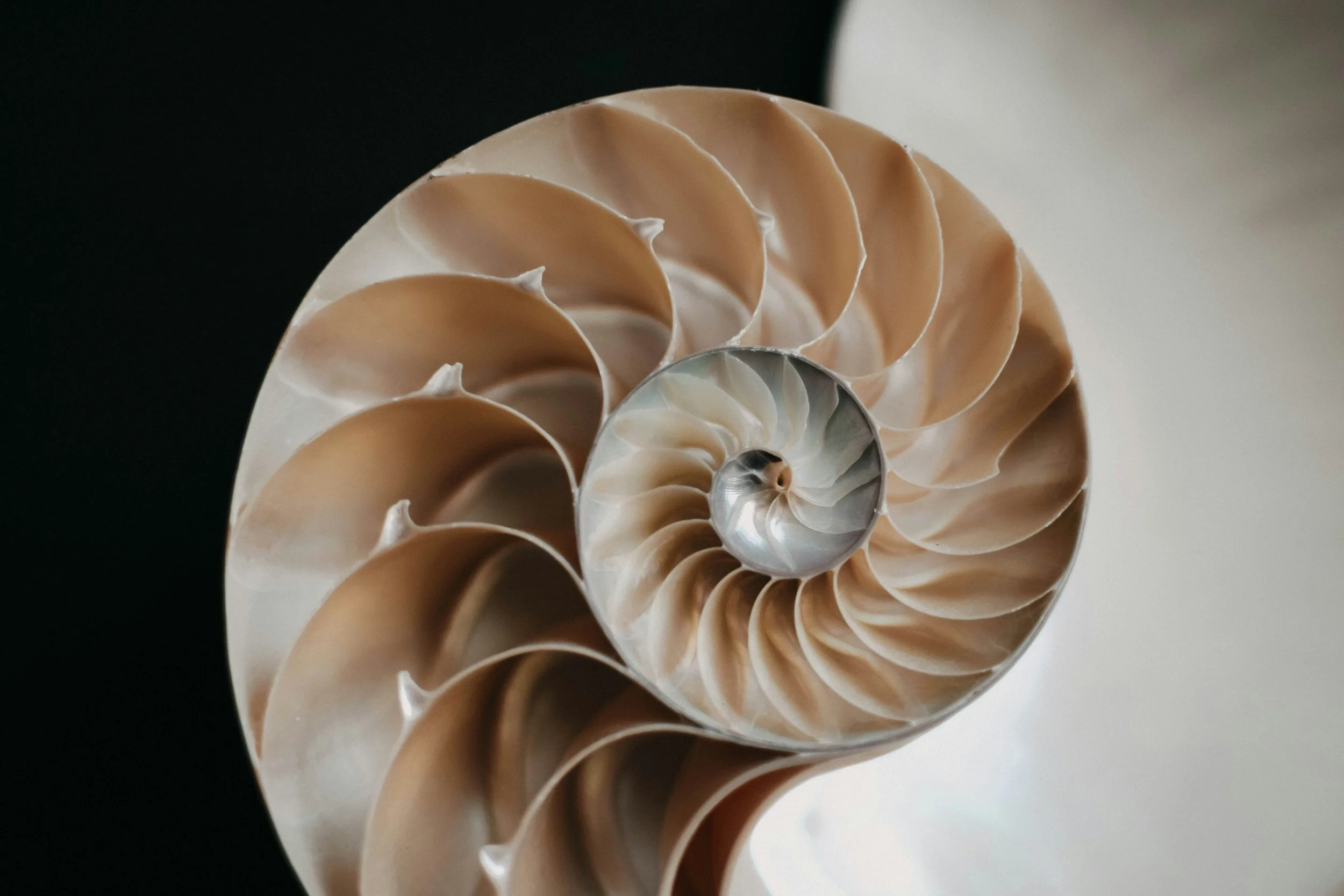
The Somatic Spiral is a five-pillar framework for nervous system regulation and self-inquiry, developed by Rachel Posner, founder of Rachel Posner Yoga Therapy, in 2025. It helps individuals build capacity for self-regulation, and trains wellness practitioners to bring these tools into their own work, through five pillars: nervous system regulation, self-compassion, deep listening, somatic parts work, and deep imagery.
The name comes from my own fascination with spiral patterns in nature — organisms built for growth, strength, and energy efficiency. The chambered nautilus is a good example: it doesn't outgrow its shell and start over, it simply adds a new chamber as it grows. The shape holds. The capacity expands. That's what this framework is designed to do. We return to the same five pillars, again and again, each time with more depth and space.
I return to these five pillars often — sometimes for something big, sometimes for something as small as sitting down to write. Even after twenty years of this work, I still sometimes find myself avoiding the page — cleaning out the refrigerator, inventing stressors, doing anything but the thing in front of me. Keep reading for the full example of how I got back on task.
Where It Comes From
Over two decades of individual and group yoga therapy, I've watched people arrive at turning points that weren't random. A client finally understanding the protective logic of their own nervous system. A subtle shift toward self-friendliness. Two parts of someone, long in conflict, finding their way into cooperation.
These moments came from the weaving of five pillars together — and from returning to them again and again, with expanding capacity.
The Five Pillars
Rooted in neuroscience. Guided by the body.
Nervous system regulation
This is the foundation the Somatic Spiral is built upon. We begin with the role of the nervous system and the basics of emotional regulation. Based on past experiences, we each have a tendency towards hyperarousal (fight or flight) or hypoarousal (freeze), and each require a different set of tools to bring us back to our parasympathetic, or social engagement, system. So we learn how to identify where we are and respond accordingly.
Self-compassion
Self-compassion is the superpower we all need to feel safe and at home in our bodies. Without it, healing and integration is often elusive. Self-compassion training is an essential part of this therapeutic model.
Deep listening
We take in information through our sensations, thoughts, emotions, and images, but our tendency is to default to only one or two of those pathways. Paying attention to all four broadens our perspective and gives us more access to our inner landscape.
Somatic parts work
Learning how to be in dialogue with different parts of ourselves — our bodies, our psyches — helps us understand our emotions and our actions. Somatic parts work is a powerful tool for building a deeper knowing of ourselves, alongside more empathy and self-compassion.
Deep imagery
Our bodies and psyches often speak the language of metaphor. Inviting our imagination into the conversation gives us more access to our inner truths than our cognition alone can offer.
A Moment From the Work
I sat down to write and nothing was flowing. I spent a silly amount of time distracting myself. I cleaned out my refrigerator, and then manufactured a number of stressors out of thin air. Finally, I managed to pull out my nervous system regulation tools and settle in.
I let go of the voice that was beating me up for procrastinating and brought in self-compassion. A quieter voice, in a friendly tone, asked, what's really happening here?
A bit of deep listening helped me understand the real issue — I was afraid that I had nothing to say. I was afraid that my message was too simplistic, not smart enough, not original enough.
I dropped into somatic parts work and talked to a younger part of me that worries she's not smart enough. I know her voice well, and once I recognized it was her, I explored some deep imagery. I imagined her sitting next to me and asked her what she was feeling. She said she was just trying to protect me from appearing too simple or too obvious, so she shut me down and turned up my procrastination and avoidance skills.
I thanked her for trying to help, reassured her that it would be okay to share, reminded her that we are in fact smart enough — and then I got to work.
Because I've practiced this before, I knew how to orient. I knew what to do. I made my way through the Spiral, accessed the tools I needed, and remembered that younger self still exists — but she's more familiar now, and much easier to engage with and integrate.
Where You'll Encounter It
The Somatic Spiral isn't a single program — it's the throughline underneath everything I do.
In one-on-one yoga therapy, it's the map we return to session after session, following your own experience rather than a prescribed path.
In The Somatic Immersion, it's a personal journey — the five pillars, explored together in community.
In The Somatic Immersion Training, it's the framework wellness practitioners learn to hold for others, alongside continuing education credit through Yoga Alliance and IAYT, over roughly 30 hours.
On retreats, it's the quiet structure underneath the experience — the same five pillars, met through yoga, nature, culture, travel, and shared adventure.
In self-paced courses, it's topic-specific — one pillar at a time.
However you find your way to this work, you're working with the same five pillars — just in different rooms, at different depths.
If This Resonates
I'd love for you to explore The Somatic Spiral with me — whether that's one-on-one, in the Somatic Immersion/Training, on a retreat, or on your own.
If you'd like some guidance around where or how to get started, schedule a connection call with me.